
Author: Malaika Letshabo
In August 2025, medicine availability across Botswana’s public health facilities fell to 17 percent. Essential medicines were unavailable, non-urgent surgeries were postponed, and hospitals reported critical shortages in theatre and chronic care supplies. On 25 August 2025, a State of Public Health Emergency was declared after government confirmed that the supply chain managed through Central Medical Stores had failed. By early October 2025, availability had reportedly improved to 36 percent. In early 2026, the Ministry of Health described the situation as steadily improving, although not yet fully stabilised, with micro-procurement still being used to address unstable stock lines. The figures alone do not explain the crisis. The legal framework governing procurement provides necessary context.
Recent budget speeches provide important context for the medical supply debate. The Ministry of Health’s recurrent allocation has steadily declined over the past three fiscal cycles, from P9.46 billion in FY2024/25 to P8.98 billion in FY2025/26, and further to P7.51 billion in the FY2026/27 budget. Treasury has largely attributed the drop to the transfer of primary healthcare functions to local government, but the numbers still shape the operating reality within which procurement reforms must occur. The 2026 Budget Speech also earmarked funding for the National Health Insurance rollout while reiterating that the health vote must continue covering core inputs such as medicines, vaccines, and surgical supplies.
What the minister has put on record about supplies and procurement
In his 06 August 2025 parliamentary statement (as reported by the state news service), Dr Modise linked medicine shortages to constrained procurement capacity and debt pressure, stating that financial obligations exceeded P1 billion and that the situation had forced measures such as the temporary suspension of elective and non-urgent referrals to private facilities. He also described immediate steps to stabilise the system, including fiscal reprioritisation and emergency sourcing approaches. A week later (13 August 2025), he gave Parliament a snapshot of availability, reporting Kgatleng East drug availability at 69.7% and Central Medical Stores at 55%, against a national target of 97%, while urging collective effort to manage the crisis.
Government then confirmed that P250 million in emergency funds had been availed (21 August 2025) to procure life-saving supplies and publicly tied the response to emergency procurement approaches and waivers aimed at removing regulatory and administrative impediments during the crisis. By 27 October 2025, Modise’s update to the public reported availability improving from 17% (August) to 36% (early October) and set explicit output targets (97% availability and a three-month buffer), alongside longer-run procurement reforms such as pooled procurement and exploring local manufacturing. As a 2026 “are we there yet?” marker, Mmegi reported Modise saying medicines were arriving but that distribution failures remained under investigation, signalling that recovery is not only about buying stock but also about getting it reliably from warehouse to ward.
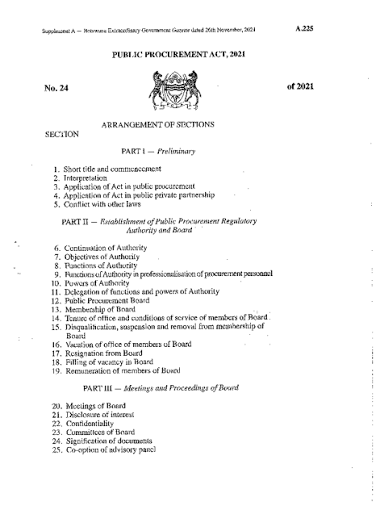
Public procurement in Botswana is governed by the Public Procurement Act, 2021 and the Public Procurement Regulations, 2023. The Act requires fairness, transparency, competition, accountability, and value for money. These safeguards are mandatory. Section 69 prohibits inviting bids or signing contracts without confirmed funds. During the period when government reportedly owed substantial arrears to suppliers, this requirement became a practical constraint. Section 104 requires a ten-day cooling-off period after a tender award before a contract may be signed, allowing aggrieved bidders to challenge decisions. Sections 106 and 107 provide complaint and suspension mechanisms which, while essential for integrity, can delay supply when disputes arise. Section 92 regulates supplier eligibility and listing requirements, ensuring accountability but potentially narrowing the supplier pool in specialised pharmaceutical markets.
When the crisis escalated, government relied on emergency procurement under Regulation 30 of the Public Procurement Regulations, 2023. Emergency procurement is permitted where there is a threat to life or public health and delay would cause serious harm. It requires written justification, Accounting Officer approval, competition to the maximum extent practicable, documentation, and quarterly reporting. Importantly, emergency procurement cannot be suspended once lawfully initiated, ensuring urgent deliveries are not halted by disputes. This shifts accountability from pre-award delay to post-award audit.
Procurement approval alone does not place medicines on shelves. The Medicines and Related Substances Act establishes the Botswana Medicines Regulatory Authority as the body responsible for registration, quality assurance, and oversight of manufacture, storage, and distribution. During the crisis, emergency imports remained subject to regulatory review to ensure safety and efficacy. Thus, Botswana operates a dual-gate system: procurement approval and regulatory authorisation. Both must function for medicines to reach patients.
Pharmaceutical suppliers and government officials acknowledged that accumulated arrears disrupted credit arrangements and supply continuity during the 2025 crisis. Government disclosures indicated that liabilities of about P1 billion owed to private facilities and suppliers constrained procurement cycles and delayed deliveries (Reuters, 2025). Health Minister Dr Stephen Modise later indicated that the financial strain altered supplier behaviour, with some demanding upfront payments before shipment as supply chains tightened (DailyNews Botswana, 2025). Government briefings during the emergency also revealed that direct sourcing from manufacturers produced significantly lower prices compared with intermediary procurement, fuelling debate within the pharmaceutical distribution sector (Reuters, 2025).
Industry observers, however, cautioned that headline price comparisons must account for freight, warehousing, cold-chain logistics, currency volatility, and compliance costs that shape pharmaceutical distribution realities. While availability has improved since the 17 percent low point, reliance on micro-procurement confirms that long-term stability is still being built.
Planned reforms to modernise Central Medical Stores, strengthen digital inventory systems, and advance strategic purchasing mechanisms, including the proposed National Health Insurance framework, will depend on procurement reliability. Clearly, there has been a trajectory shift. We remain hopeful for the improvement of our health sector and a much better chapter, with new bills tabled as well as financing and structural reform.
 The Current Connect Student Club